Tuesday, February 28, 2017

Whisky I've Drank: Whyte & Mackay Aged 13 Years

By Richard Thomas
Rating: C
In a nutshell, Whyte & Mackay blend their scotch twice. The first blending is of single malts, which are mixed together and then aged in old sherry casks. After a time, the scotch is then mixed with grain whiskey and stored in a fresh set of sherry casks for a further year of aging. Therefore, whatever the age of a Whyte & Mackay scotch, most of it is spent in that first stage, with the final mixing and aging serving as sort of a finishing process. Taken as a whole, the process is most unusual, since it is more common in whiskey-making to blend the product either before or after after aging, rather than before and in the midst of aging.Whyte & Mackay are a Glasgow label, have been in the scotch whiskey business since 1844, and are now owned by an Indian conglomerate. This is another one of those labels that, like VAT 69, were famous several decades ago (Shackleton took the stuff with him to Antarctica, and you can see boxes of Whyte & Mackay in the classic gangster film Public Enemy), but are largely forgotten in modern times. However, the label is recognizable for its thoroughly British double lion iconography, while the scotch itself is distinguished by Whyte & Mackay’s “double marriage” maturation process.
The Scotch
Whyte & Mackay’s 13 year, also referred to simply as “The Thirteen,” is their second-tier scotch, only one step up from the entry-level “Special” label. The bottle is pretty standard stuff, with a metal screw top, and shows off the scotch’s glowing amber-gold coloring nicely. My bottle came with an aerator, however, and I simply detest those things. As the name implies, it is bottled after 13 years of maturation, and at 40% alcohol.
The scent of the Thirteen is subdued and mellow, with a hint of sherry. The flavor of Whyte and Mackay’s 13 year continues the mellowness, becoming floral, sweet and just a little spicy. The scotch washes down with a mildly spicy finish.
The Price
Whyte and Mackay isn’t common in the United States, and if you can find a bottle, it will retail for between $25 and $35. It is somewhat more common in Europe, where you often find it priced for between 16 and 18 euros, but sometimes as much as 20 euros. If you are traveling in India, Whyte and Mackay becomes a nice choice compared to some of the rotgut being passed around there as “whiskey.”
Awards
Whyte and Mackay’s 13 Year Old won a Silver at the 2010 International Wine and Spirits Competition.

Saturday, February 25, 2017

Whisky I've Drank: Dewar´s Aged 12 Years - The Ancestor


By Josh Peters
Dewar’s 12 Years is a whisky I’ve been wanting to try for a while. It’s no secret that I’m not a huge fan of the regular Dewar’s White, I’ve expressed that on more than one occasion, but something like this hopefully showed some promise. Since it carries a 12 year age statement that means every component, both grain and single malts, need to be aged at least 12 years and as we’ve discovered over the years, aged grain whisky can be quite nice.
True 12 years is some distance from the 25+ where grain really starts to get good, but it’s a large leap up from the minimum 3 years that’s needed to allow it into NAS blends. The single malts follow the same route and every drop of Aberfeldy, Craigellachie, Royal Brackla, The Deveron, Aultmore, and all the rest are at least 12 years old. Which is great, but then they go and neuter it by dropping the ABV down to 40%. So is life.
Dewar’s 12 Years Info:
Region: Scotland
Blender: Dewar’s
Cask: Various
Age: 12 years
ABV: 40%
Price: $25
- Dewar’s 12 Years Review:
EYE
Caramel – me thinks thar’s some e150 in ‘ere.
NOSE
Caramel, smoky malt, citrus peels apple, spice, strawberry frosting and a touch of iodine, graham and fresh pastries. It’s not a dense aroma, rather light and etherial, but it’s definitely a pleasant aroma. I have no qualms with what’s going on, I just wish it were bolder.
PALATE
Caramel, orchard fruit, sweetness, malt, touch of smoke, strawberry frosting with a bit of spice, raisins and cocoa. Like the nose it’s a great experience overall, it just happens to be so light that it leaves me wanting more.
FINISH
Short drop of toasted grains, citrus, smoke, malt and dried fruit.
BALANCE, BODY & FEEL
Good balance, thin body, soft nearly watery feel.
OVERALL
Dewar’s 12 is a decent sipping whisky and something I’m very glad I tried, but it’s also something I’m a bit disappointed in. When doing a blind Aberfeldy tasting at Malt Nuts we tasted one of the older 43% bottles of the Dewar’s 12 and I enjoyed it quite a bit. I thought it had some real character to it, but it seems that small 3% drop in ABV has noticeably dulled it down.
It’s still a decent dram and as a way to kick off an evening or sit and sip after a meal it works well, it also makes an acceptable Rob Roy, the only thing it’s really missing is some richness. I would love to experience this whisky at 46%, non-chill filtered and with no e150. It has enough good things going on inside of it that with less water, and leaving it’s natural oils intact, it could easily go from a decent blend to a great whisky.
SCORE: 81/100 (B-)*Disclosure: This sample of Dewar's 12 Years was graciously sent to me by the company for the purposes of this review. The views, opinions, and tasting notes are 100% my own.
Dewar's 12 Years Review - Score Breakdown
Nose - 83
Palate - 82
Finish - 80
Balance, Body & Feel - 79
Summary:
Dewar's 12 Years is a fun whisky and should definitely not be overlooked if you’re searching for something cheap and easy to sip.

Saturday, February 4, 2017

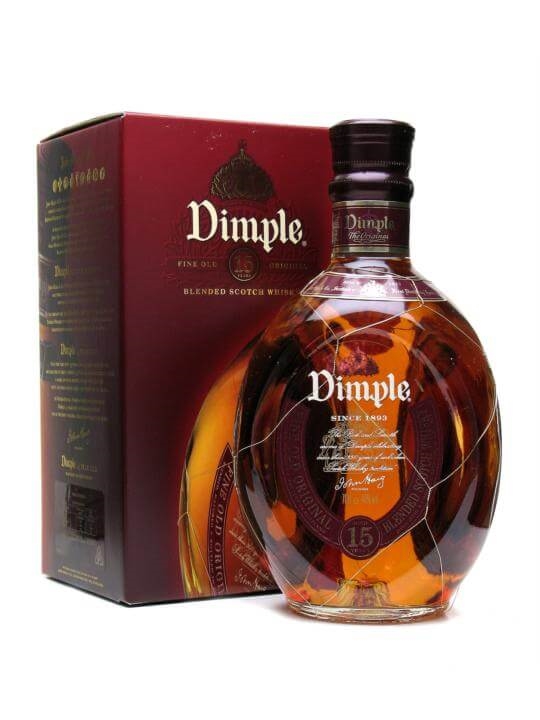
Whisky I've Drank: Dimple/Pinch Aged 15 Years


By Richard Thomas
Rating: B-
The name comes from the dimpled bottle design used by Haig in the 1880s or 1890s (reports vary), leading to the introduction of the Dimple 15 Year Old blend we know today. Reportedly, it contains a higher than normal malt proportion, including stuff from Glenkinchie and Linkwood. Yet as is the norm with the Scotch business, just how high “higher than normal” is, let alone how much comes from Glenkinchie and Linkwood, remains undisclosed.Haig Dimple 15 Year Old is a common sight on European bar shelves, so much so that I would say it is the 15 year old blend I see the most of. So on the Continent, we know it for what is more or less its omnipresence; in America, it grabbed renewed attention for appearing on the Breaking Bad. In the USA, it is labeled as Dimple Pinch rather than Haig Dimple, but Dimple is Dimple and the stuff in the bottle is the same.
The Scotch:
While Dimple might be a middle-aged blend, it is still essentially a mass market product, and consequently is bottled at 40% abv. The packaging is certainly pretty, though: a hefty, rounded-but-triangular, dimpled clear glass bottle with golden netting, topped by a hefty cap.
One of the good things about that bottle is how it shows off Dimple’s color, a pleasant light amber, somewhere in the place where orange meets gold.
The key characteristic of Dimple is how light and understated it is. The nose is floral and toffee and caramel sweet, underscored by a dry woody note. The flavor has a medium-bodied, butterscotch and toffee character, with a light, but still spicy pepper note and a tinge of dry wood. The flavor unfolds off the pepper, leaving a restrained afterglow with light warmth.
The Price:
Dimple has a fairly solid international following, and it’s not hard to see why. One might look at the age statement and go “that must cost a pretty penny,” but it actually doesn’t. The numbers on Dimple seem to be around a consistent “35” wherever I see them, in dollars, pounds, or euros. For Americans, that means a nice blended scotch priced in the same range as the typical small batch bourbon, and for Europeans makes for a good deal.

Saturday, January 28, 2017

Whisky I've Drank: Glen Moray Aged 12 Years


By Josh Peters
What do Aberlour, Glenmorangie and Whisky Label 5 all have in common? Their owners have all owned the Glen Moray distillery at some point in time since it’s conversion from a brewery to a distillery in 1897. This scrappy little distillery has been caught on fire, allowed to run down, closed for over a decade and brought back online during it’s 117 years. It’s the little distillery that could.
It’s flagship product, the Glen Moray 12, is an interesting little guy. It has so much potential and so many nice things going on that I find myself rooting for it and spending more time than I usually would hunting and searching for more. Hoping that there is some hidden depth to this whisky that I just didn’t taste the first, second, third or fourth time… but alas, that is not the case as you’ll see in the review below.
Glen Moray 12 Review:
ABV: 40%
Age: 12 years
Price: $42
Distiller: Glen Moray
EYE:
Light Gold
NOSE:
Initial notes of caramel and lemon zest waft up from the glencairn and pave the way for some fruit and floral notes to come sifting through. A bit of honey, vanilla and whisky spice notes come drifting through with a touch of oak and herbs. It may sound like there is a lot going on… but there isn’t. It’s all very light and airy. Coming drifting through as hints and wisps.
TASTE:
The fruit has turned a bit towards the dried variety, but the vanilla and honey notes have stayed true to what they were on the nose. Malt, whisky spice and a toffee like sweetness move about on a lightly nutty underpinning. The flavor, like the aroma, suffers from being too light. The flavors feel very topical with no real depth to them.
FINISH:
Honey, malt, spice and wood dominate the rather short finish with some light notes of fruit playing in and out during the quick fade.
BALANCE, BODY & FEEL:
The balance is pretty good, but the body is really light and it feels like water.
OVERALL:
It’s one of those whiskies that I don’t hate, am glad I tried, but won’t be trying again anytime soon because I’m let down by it. There was nothing offensive about it and the aroma and palate both had some nice aspects to them, but they came across far too light and flighty, It’s like the diet version of a really good Speyside and leaves me wanting more, but never quite able to find the substance I want in this glass. This is definitely a whisky that needs a higher proof and maybe even another year or two in the barrel.
SCORE: 80/100

Friday, January 20, 2017

Whisky I've Drank: Highland Park Einar


By WhiskyGospel
Marketing is serious big deal for every product and hard to master skill, right? When we look at the single malt whisky market and marketing we can notice that most distilleries core range malts stick to age, barrel types and usages and other whisky attributes to brand, label, tag and market their whiskies.
However, sometimes when you need to market unique and special products to specific crowded and competitive market (and audience), the question that probably rises in those marketing teams – how do we make it stand out so people will buy our products and not the others (or both, but make sure ours are in your basket…).
You’ve probably guessed (correctly) that I’m talking on the Travel Retail whisky market. Here, the rules are different and different distilleries takes different route – some (the minority) will relay on the strong existing distillery brand and reputation and will sticks to the usual conventions (Hello Balvenie Triple Cask 12, 16, 25!) but most will launch new products which are named after external objects – important places for the distilleries, historical places, ships and persons – instead of whisky age/cask/attributes and usually without age statement.
This year, Highland Park distillery launched exclusively for the Retail Travel market -the warriors series – there are six bottlings in this series and the first three that were released already are Svein, Harald and Einar and very soon we’re supposed to see Sigurd, Ragnvald and Thorfinn which were slated for summer release.
In the last local tasting event which focused on highlands whiskies, we also tasted Highland Park Einar for the first time.
The Warriors bottles, as most bottles of that kind, do not have age declaration – quite a common and worrisome trend lately with the rising demand for single malt whisky and dwindling stock of old casks.
So a competitive market, distillery with good reputation, whisky with no age statement – how good is Einar?
Nose: 
We get a combination of fruity notes with minor sherry influence, sweet vanilla, some malty notes and lots of spices like cinnamon and pepper, overall nice but not very complex.
Palate: 
What the nose promise, the palate delivers. A rich mix of all those notes we sniffed coats the tongue with some weak smoke note that hides in there.
Finish: 
Medium, spices and oak dominates here with some lingering vanilla added to the recipe.
Conclusion: 
It’s a decent one and Highland Park continue to produce good stuff, although I’d still go for HP 18 if I have to choose between them (despite HP 18 being £13 more expensive). I wish that the ABV would be higher for those warriors bottles with little more Oomph – other tasters in the event said it feels a bit watered down and at 46% it would probably be even better. I think those forthcoming 3 warriors with the higher ABV (and older spirit) seems like a good bet to excel even further.

Thursday, January 12, 2017

Whisky I've Drank: Grant's Aged 21 Years


Ten (10) first-class malt whiskies, including selected casks from the warehouses of Glenfiddich and Balvenie, are skilfully blended with Scotland's finest Grain whiskies to create the exceptional smoothness, mellowness, and rich, full flavor of William Grant's 21 Year Old Rare Scotch Whisky.
Every whisky in this rare old blend has been aged in oak casks for at least 21 years.
GRANT’S AGED 21 YEARS Blended Scotch Whisky. 700ml, 43% ABV.
IWSC Gold medal winner.

Wednesday, January 4, 2017

Whisky I've Drank: Glenmorangie "The Nectar D´Or" Aged 12 Years


By Whisky Kirk - July 7th, 2016
Glenmorangie Nectar D’or 12 Year Old is finished in Sauternes wine casks, which is pretty cool, if you ask me. This wine comes from the sauternais sub-region in France that is located in the Graves section of Bordeaux . No, vineyards were not planted atop human remains there.
Or were they? Well, if a correct translation of “grave” is any indication, then the answer is an emphatic non-non. In French, it means “soil with a concentration of gravel.”
When harvested, sauturnes grapes are spread out in the sun to let some of the juices inside the skins evaporate, thus concentrating what is left (as the sun takes them part way towards becoming raisins). This process results in a white desert wine that is quite sweet, indeed.
Casks used in the production of white desert wine are loaded with sugars, and these naturally find their way into Nectar D’or whisky. Actually, it’s worth pointing out that the wash is aged in ex-bourbon casks for a decade, and then finished for two years in the aforementioned desert wine casks.
All of these facts add up to great news for connoisseurs who like their whisky sweet and fairly complex. It’s worth pointing out that Nectar D’or means “golden nectar,” as “Or” is the Scottish Gaelic word for “gold.” Along with sweet flavors from the wood, there comes a nice deep golden color– hence the appellation that calls attention to the color of this whisky.
Before we move on to the tasting notes, I might as well mention that Glenmorangie was one of the first distilleries to legitimize the practice of finishing its whiskies in wine casks. Yes, I know that I’m starting to date myself, but I actually do remember a time (a few decades ago) when finishing whiskies in wine casks was generally thought of as “iffy” and controversial.
Today, finishing is done quite a lot by some very reputable distilleries. I think that Glenmorangie deserves credit for showing the world how it was done– not only in terms of creating some award-winning single malt Scotch whiskies– but also in demonstrating how the practice of finishing batches in wine and port casks could be profitable. Of course, it doesn’t hurt that the same parent corporation owns Glenmorangie distillery, in addition to the vineyard in France that makes Sauternes wine, and, by extension, owns the casks used to make Nectar D’or.
Tasting Notes: Glenmorangie Nectar D’or 12 Year Old
Color: 
Deep gold in the bottle; a bit lighter “old” gold in the glass.
Nose: 
Floral notes combine with vanilla and honey to offer a very rewarding olfactory experience. Pinot Gris surfaces, along with white grape skins, almonds, and rose water. A citrus note seems to be floating in there, as well, although it is fairly subtle on the nose.
Palate: 
On the tongue, lime and orange zest greet the palate. Ex-bourbon casks add a bit of pepper to the sweeter floral nature of the nose. Now, I’m getting apple blossom–so, yes, I can isolate the type of floral influence, as well as the type of citrus influences on the palate. Cinnamon dances around a pool of vanilla and golden raisins. Alcohol in the mouth feel is a little on the hot side for 46%, but this heat compliments a touch of peppery spiciness from the oak.
All told, the interplay of sweet and spice adds welcome complexity for a twelve year-old offering. The finish is medium in length, and its death brings honey suckle and vanilla, rather than wood spice. In terms of texture, the viscosity is not thin, but neither is it “chewy” from oak tannins.
Rather, I should say the whisky is somewhat oily in the way it interacts with the tissues of the mouth, particularly after resting in one’s glass for a spell. Put another way, it’s mouth-coating without being chewy. Few experts would argue against the fact that a higher ABV, together with more time in the casks, would move this whisky in a fascinating direction. However, given its price-point, we can be appreciative of the role Nectar D’or plays in Glenmorangie’s twelve year core offerings.
Conclusion:
Glenmorangie Nectar D’or comes in a rather handsome box–complete with hinges, clasps, and golden lettering embossed on a matte finish. You can’t go wrong if you bring it to a wedding, an old-fashioned wake, or if you present it as a gift–either to somebody else, or to yourself.
My only complaint about the nectar in my glass is the fact that it replaced Glenmorangie’s Madeira wood finish. I do love the influence of fortified Portugese wine casks on a good whisky, and so I’ve missed the Madeira wood. This said, today’s Sauternes finish is admittedly more viscous, which creates a nice, oily mouth feel.
Last time I checked, the discontinued green label Madeira was fetching upwards of two hundred pounds at auction. That’s too too rich for my blood, but it would be fun to do a side-by-side comparison between the two whiskies at some point. If a Madeira wood happens to surface at a friend’s house during a whisky tasting in the future, then I most likely drive to the nearest liquor store on a quest to bring back Nectar D’or Sauternes finish for the piece de resistance of the event.
FINAL SCORE: 87/100.